





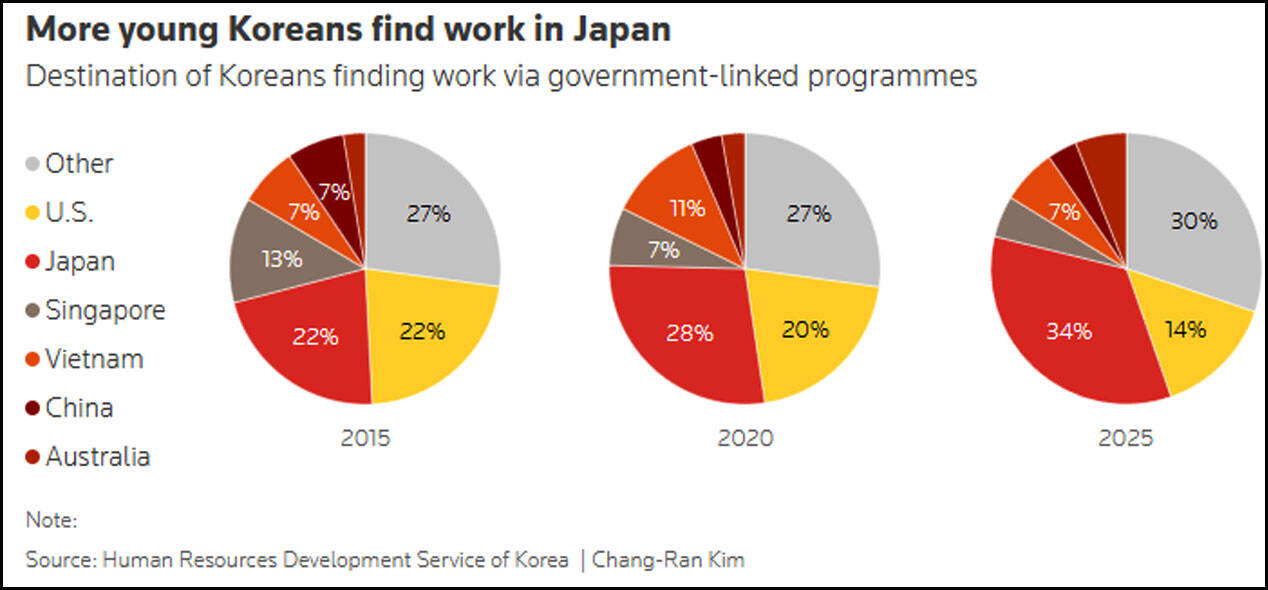
When Japanese entrepreneur Moe Kasugai was studying at Seoul’s Yonsei University, she noticed that many highly capable graduates were struggling to find suitable employment opportunities despite having strong academic backgrounds and language skills.In 2019, Kasugai launched KOREC, a service aimed at connecting South Korean job seekers with Japanese employers. The startup has since focused on helping young Korean professionals explore career opportunities in Japan, where companies are facing challenges in filling graduate recruitment programmes.“I was surprised that they couldn’t find a job because they were so smart,” Kasugai told Reuters at a two-day job fair organised by KOREC in Seoul last month. “Many could speak Japanese, so I thought it might be better for them to go to Japan. I wanted to help.”Japan’s labour shortage creates demand for Korean graduatesSouth Korean young people continue to face difficulties in securing desirable entry-level jobs. Major employers, including large technology and manufacturing companies, often seek candidates with previous work experience, while older employees are remaining in positions for longer periods.Japan, meanwhile, is experiencing a shortage of young workers as its ageing population creates recruitment challenges for companies. Many Japanese firms maintain graduate hiring systems that provide structured training for new employees, creating opportunities for overseas graduates who meet language and skill requirements.Although average salaries in South Korea have recently moved slightly above those in Japan, demand for Korean talent has increased. Technology recruitment companies including South Korea’s Wanted Lab and Japan’s LAPRAS launched similar talent placement services this year, following the earlier entry of Mynavi.South Korea has also hosted several Japan-focused job fairs this year, featuring companies such as Canon Imaging Systems and industrial automation company Azbil. According to the latest monthly data for June, South Korea’s youth unemployment rate was 7.0%, while Japan’s overall unemployment rate stood at 2.5%.Korean professionals expand presence in JapanWhile many foreign workers in Japan are employed in blue-collar sectors, more than 80,000 Koreans working in the country commonly hold professional roles in industries including retail, information technology and game development, according to the Korea Labor Institute.The Human Resources Development Service of Korea recorded 2,257 young Koreans taking jobs in Japan last year through government-supported programmes, a 47% increase from 2024. Japan became the leading destination for overseas employment among young Koreans, while the number moving to the United States declined by 29%.University student Kim Si-hyeon, who attended the KOREC job fair with more than 100 other applicants, said many young Koreans interested in Japan already had an interest in living there.“Most people I know who are looking for jobs in Japan already had an interest in living there,” Kim told Reuters.Kim, a fourth-year Japanese studies student at Dongguk University, said Japanese companies’ training systems were an important attraction for graduates.“Korean companies tend to prefer experienced workers, while Japanese companies still recruit new graduates,” Kim said, adding that she was looking for opportunities in information technology or AI.Language skills give Korean applicants an advantageLee Chang-min, a professor at Hankuk University of Foreign Studies, said Korean candidates were attractive to Japanese employers because of their language ability and cultural familiarity.“In terms of language and culture, the quality of Korean candidates is overwhelmingly high. There aren’t many foreign applicants who can use Japanese at the level required for actual work,” Lee told Reuters.Tomoya Hattori, head of Japanese consultancy Energize, said companies were focused primarily on finding capable employees rather than selecting candidates based on nationality.“If there’s a good candidate, we want to hire that person,” Hattori told Reuters at the job fair.
Companies face challenges retaining foreign employeesDespite growing recruitment links, Japanese companies may face difficulties retaining Korean employees. Kasugai said many Korean workers prefer changing jobs to pursue better career opportunities and higher salaries, which can conflict with traditional Japanese employment practices based on long-term service.“It’s definitely a stumbling block for Japanese companies,” Kasugai told Reuters. “Still, young Japanese people are job-hopping more and more these days, so I think Japanese companies’ understanding will eventually adjust.”Lee said retention risks increase when companies provide lengthy training but offer limited opportunities for employees to apply their skills across different roles or advance quickly.For Kasugai, the movement of Korean professionals to Japan also contributes to stronger social connections between the two countries.“When Korean people go there and work, exchanges begin with Japanese colleagues who may never have had a Korean friend or known much about Korean culture,” Kasugai told Reuters. “That is something a private company can help create.”(With inputs from Reuters)