



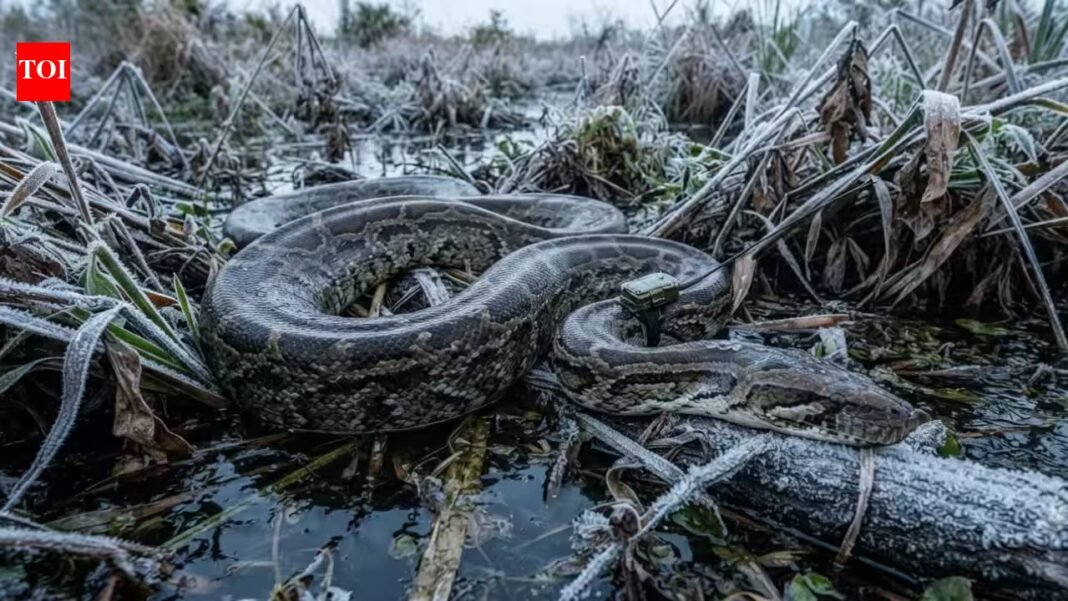
For years, winter temperatures have been considered one of the biggest obstacles preventing Burmese pythons from spreading beyond the warmer parts of Florida. The invasive snakes have established a breeding population in the Everglades, where their presence has been linked to major changes in native wildlife populations. But genetic research has raised questions about whether the cold might remain such a reliable barrier. Scientists studying the Florida population have identified signs of evolutionary changes associated with temperature sensing, behaviour and physiology. The findings suggest that some pythons may be responding to conditions their ancestors were less equipped to handle, although the extent of their ability to survive in much colder regions remains uncertain.
Why Florida’s Burmese pythons struggle when temperatures drop
Burmese pythons are native to South and Southeast Asia, but they have become established in South Florida after being introduced through the exotic pet trade. The Everglades now supports a substantial invasive population, with the snakes preying on a wide range of native animals. Their ability to survive and reproduce in an unfamiliar environment has made them the subject of continuing research into invasive species and their capacity to adapt.Cold weather, however, has presented a serious challenge. A prolonged cold spell in January 2010 offered scientists an opportunity to examine what happens when these tropical reptiles encounter temperatures well outside the conditions they usually experience in South Florida. The event caused considerable mortality among monitored pythons, suggesting that freezing conditions could restrict the population’s expansion into colder parts of the country.
Genetic changes may help pythons cope with colder conditions
A 2018 study published in Molecular Ecology, titled ‘Novel ecological and climatic conditions drive rapid adaptation in invasive Florida Burmese pythons’, examined genetic material from Florida pythons collected before and after the January 2010 cold spell. The research team, which included scientists from the US Geological Survey, looked for differences that might indicate how natural selection was acting on the population.Their analysis identified signs of directional selection in genomic regions associated with temperature sensing, behaviour and physiological processes. The findings suggested that the 2010 cold event may have favoured pythons carrying genetic variations that provided an advantage under Florida’s environmental conditions. The researchers described this as evidence of relatively rapid evolutionary adaptation in an invasive population.The findings do not mean that the snakes have developed an ability to withstand freezing temperatures without difficulty. Rather, they point to changes that could improve their chances of surviving environmental stress. The researchers also identified physiological differences involving the way the snakes maintain digestive activity, which may help them sustain higher metabolic rates and body temperatures during periods of cold.
Why the snakes’ digestive system matters
Burmese pythons have an unusual digestive system. After consuming a large meal, their internal organs undergo substantial changes to process the food. Their metabolism rises considerably during digestion and then falls during periods of fasting.The 2018 research suggested that maintaining a more active digestive system could offer an advantage under Florida’s changing climatic conditions. The associated physiological changes may help the snakes maintain higher metabolic activity and body temperature when temperatures fall. Several of the genomic regions identified in the study were also associated with regenerative organ growth, a process involved in the changes that take place between feeding and fasting.This does not establish that the snakes can generate enough internal heat to survive severe winters. Burmese pythons remain ectothermic reptiles, meaning they depend largely on external sources of heat to regulate their body temperature. Their ability to find suitable shelter and use warmer surroundings remains important to their survival.
How the 2010 winter tested Florida’s invasive python population
As reported by the US Geological Survey, the January 2010 cold event had provided an important warning about the limits of the invasive population. Scientists tracking Burmese pythons in South Florida recorded substantial losses during the prolonged period of unusually low temperatures.Of the 10 radio-tracked snakes whose fate was established, only one survived. Among another 99 snakes for which researchers could determine the outcome, 59 survived. Some of the tracked animals appeared to respond poorly to the conditions, attempting to bask rather than retreat into sheltered places where they might have been better protected from the cold.This demonstrated that temperature could have a direct influence on the population’s survival. It also provided the setting for the later genetic investigation. The later genetic investigation examined whether environmental pressures, including the 2010 cold event, may have favoured certain inherited characteristics within the Florida population. However, it did not establish that the single radio-tracked snake that survived possessed a particular genetic variation responsible for cold tolerance.
What a study of 400 Florida pythons revealed about their family tree
Cold adaptation is not the only genetic question surrounding the Everglades pythons. A separate USGS study, published in 2018 in Ecology and Evolution, examined around 400 snakes captured across South Florida between 2001 and 2012. It found that many individuals were closely related, with average genetic relatedness falling roughly between that of first and second cousins.The investigation also identified Indian python mitochondrial DNA signatures in at least 13 snakes. This suggested that these individuals had Indian python maternal ancestry, potentially indicating hybridisation between Burmese and Indian pythons. The two species have different habitat preferences in their native ranges, with Burmese pythons generally associated with wetter environments and Indian pythons more commonly found in drier habitats.Scientists suggested that genetic mixing could potentially give some offspring a wider range of characteristics, helping them cope with different environmental conditions. However, this research was separate from the investigation into cold-related genetic selection. It did not establish that Indian python ancestry was responsible for the changes associated with temperature tolerance.
Climate projections have raised questions about a wider range
The possibility of Burmese pythons spreading beyond Florida has also been examined through climate modelling. A 2009 study published in Biological Invasions assessed climatic conditions across the continental United States by comparing them with temperatures and rainfall recorded near the edges of the snakes’ native range in Asia.The researchers mapped areas with potentially suitable conditions under present-day and projected future climates. Their modelling suggested that parts of the United States could become climatically suitable for the snakes by 2100, including areas farther north than their existing range. The projected regions included parts of Washington, Colorado, Illinois, Indiana, Ohio, West Virginia, Pennsylvania, New Jersey and New York.These projections were based on climatic similarities, rather than evidence that Burmese pythons had already established populations in those places. They also did not demonstrate that the snakes could survive every cold spell in those regions. Temperature is only one factor influencing whether an invasive animal can establish itself, alongside food availability, suitable shelter, breeding conditions and other ecological pressures.
How far could the invasive snakes eventually spread
The genetic findings have complicated earlier assumptions about the ability of Burmese pythons to remain restricted to warm parts of the country. If some inherited variations improve their response to colder conditions, the population could have a greater capacity to cope with environmental changes than scientists initially expected.Severe winter conditions can still cause substantial mortality, and the 2010 observations demonstrate how exposed the population remains when temperatures drop sharply. The 2018 genetic study provides evidence of evolutionary changes within Florida’s invasive population, but it does not establish the temperatures the snakes can withstand or identify a precise northern boundary for their future distribution.