



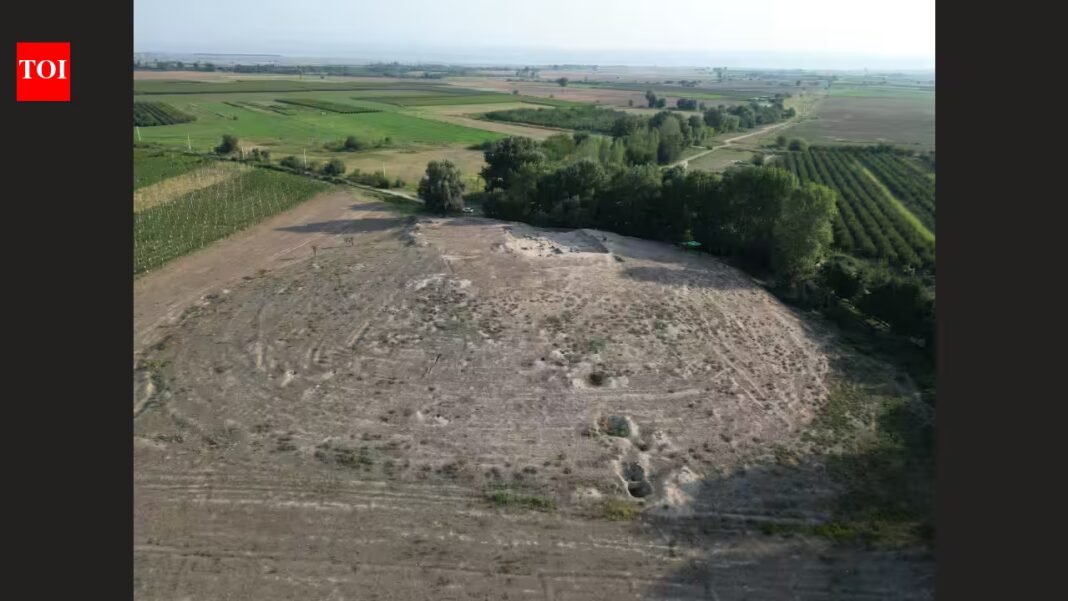
Archaeologists have discovered ten clay storage bins at Göytepe, an ancient Neolithic settlement in Azerbaijan’s Tovuz District, during excavations conducted in 2026. Measuring approximately 40 to 70 centimetres in diameter, the installations were built using clay mixed with straw and are believed to have formed part of a single storage complex. According to Azerbaijan’s National Academy of Sciences’ Institute of Archaeology and Anthropology, the bins belong to the settlement’s fourth occupation phase and were identified in half-square 3A2. Their complete excavation has been postponed until the next research stage, which will further investigate the settlement’s structures and occupation layers.
Archaeologists discover a possible Neolithic storage complex in Azerbaijan
The discovery was made during the 2026 season of the Tovuz Archaeological Expedition at Göytepe, an ancient settlement in Azerbaijan’s Tovuz District. Researchers investigated architectural remains, occupation horizons and structures associated with domestic and economic activities. The ten storage installations were recorded in half-square 3A2, where their arrangement and construction were documented.The institute’s report states that the bins’ dense concentration suggests they may have formed elements of a single storage complex. Their walls were constructed from clay mixed with straw, and each installation measures approximately 40 to 70 centimetres in diameter. The report also confirms that the structures belong to the fourth occupation phase, although their complete excavation remains pending.
Göytepe preserves 14 occupation phases of Neolithic history
Göytepe is an important Neolithic settlement in western Azerbaijan that provides an opportunity to investigate the lives of early farming and pastoral communities in the Kura River basin. According to the institute, the site measures approximately 145 metres in diameter, has cultural deposits 11 metres thick and covers an area of more than two hectares.Investigations carried out between 2008 and 2013 under international cooperation resulted in the excavation of approximately 1,000 square metres and the identification of 14 occupation phases. Excavations continued in subsequent years. Following a hiatus, cleaning and documentation work was undertaken during the summer of 2025. The 2026 research programme was linked to the project titled “Investigations of the Göytepe Neolithic Site”, conducted under the direction of Farhad Guliyev.
Archaeologists document previously unrecorded structures at Göytepe
During the 2026 season, archaeologists examined previously excavated areas and compared archival plans, drawings, photographs and measurement records with the surviving remains. The work covered relevant half-squares in Squares 1A, 1B, 2A, 2B, 3A and 3B. Researchers documented circular mudbrick structures, wall remains, hearths, courtyard areas and installations associated with domestic and economic activities.In half-square 3A1, the outline of circular Structure No. 650 was defined more clearly, with its preserved diameter measured at approximately 2.10 metres. Remains of Structure No. 649 and hearths showing evidence of intensive burning were also recorded. In half-square 3A2, researchers identified and documented Structures Nos. 651 and 652, which had not been separately recorded in earlier documentation.
Pottery and obsidian artefacts recovered during Göytepe excavations
The material recovered during the excavation season included pottery sherds and obsidian artefacts. According to the institute, the limited number of finds in some loci and the concentration of hearths and storage bins in others were interpreted as preliminary indicators of functional differences between areas. The report states that these conclusions are based on initial field observations and will require further investigation.The next stage of research will focus on structures, storage bins and lower occupation horizons that have not yet been fully excavated. Researchers will also continue measures to protect and conserve exposed architectural remains. The institute reported that identifying the ten storage bins as a single complex, alongside the newly documented structures, had provided additional information about the economic and architectural organisation of the Göytepe settlement.